Ahh, know-it-alls! A typical model railroad club contains a variety of personality types, and there’s always a know-it-all or two in the mix. You know the type: the guy with all the answers that you never asked for. The guy who relishes calling you out for some perceived shortcoming in your hobby activities. If you’ve ever wondered why “Rule #1: It’s My Railroad” has become such a popular refrain within the hobby, it’s because of this guy. So what if some hoppers in my 1949-era coal train have the Pennsy “shadow keystone” logo from 1954? So what if my Lackawanna Trainmasters are equipped with Mars lights? So what if my North Coast Limited is pulled by Alco PAs, instead of F-units? Maybe I don’t know it’s wrong, but even if I do, I don’t care. It’s model trains. I like what I like. Lives do not hang in the balance.
Full disclosure: I’m a recovering know-it-all myself. Yeah, I used to be that insufferable teenager with access to lots of railroad literature and poor social skills. Eventually I realized that my friends in the hobby kept me around in spite of this propensity, not because of it, and I started keeping my mouth shut. I still geek out on the obscure trivia as much as I ever did, of course, but I’m not flaunting it anymore. If somebody asks me, and I know the answer, I’ll give it. If I don’t know, I’ll say so. If they don’t ask, they neither want nor need my input. My goal is to become the good kind of know-it-all.
For advanced players, there’s a way to flip the script on know-it-allism. Simply present something that looks wrong, and wait for the know-it-alls to pounce. There was a guy in our club, he’s been gone ten years now, who was a master at this. He’d enter his outside-braced wooden caboose, resplendent in green Burlington Northern paint, in a modelling contest, and wait for some judge to tell him that even if BN had wood cabooses, they certainly wouldn’t have given them a full repaint in the ’70s. Then he’d smile as he produced a prototype photo of that exact caboose, in that exact paint. It’s the perfect kill shot for any know-it-all.
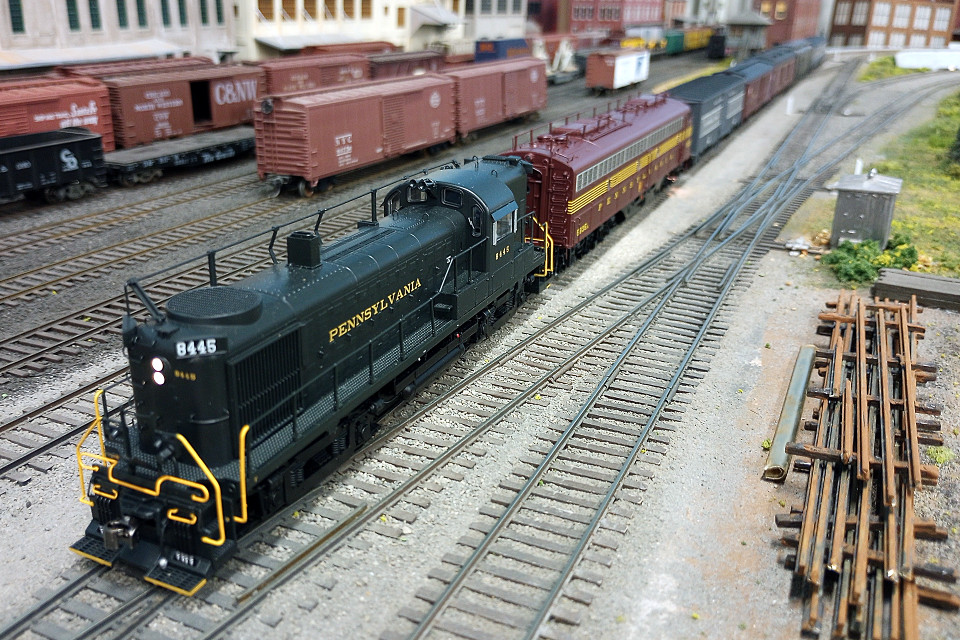
I’m not on that level, but I’ll take the opportunities that arise. Hence my partially-complete HO scale model of the Pennsylvania’s Buffalo Day Express. I still have to gather some cars to complete the train, but the motive power has arrived. I have a Bowser RS-3 and a Rapido E-8 picked just for the job.
The RS-3 is what gets the attention, naturally. “Wait, that’s a freight engine,” they say. “Why do you have it on a passenger train?”
Heh, heh, heh.
It’s true, RS-3s were usually regarded as a freight engine, although some railroads did use them in commuter service. This particular RS-3, PRR 8445, was unique. It was delivered by Alco in a batch of engines mostly intended for pusher service over Keating Summit in northern Pennsylvania. The Pennsy wanted a locomotive that could also serve as a backup passenger engine to protect trains to Buffalo. (As far as the PRR’s passenger train network was concerned, Buffalo was a backwater. They weren’t willing to park a perfectly good E-unit that far out just for emergency purposes.) Equipping an RS-3 with both dynamic brakes (for helper duty) and a steam generator (for passenger service) necessitated raising the short hood. Thus was born PRR 8445, the Pennsy’s (and later the Lehigh Valley’s, and still later Conrail’s) one-and-only “hammerhead” RS-3. It was probably the most versatile engine the Pennsy ever purchased.
So, I’ll run the train at the club, and should a know-it-all strike, I have my response ready: this photo of PRR 8445 in this very scenario, saved on my phone.
 Furniture Railroads