You’ve got to admire Union Pacific’s steam program. I’ve been reading about it my entire life. There’s the 844 (or as we once knew it, the 8444), the 3985, and then the 4014. Big mainline locomotives, each of them, operating for the very same railroad they were built for. What’s not to love? But Union Pacific, historically speaking, never came closer to me than Omaha (and later, Chicago). Those locomotives might as well be operating on a different planet.
That changed a few months ago, when it was announced that 4014 would be making a first-ever eastern tour, courtesy of potential merger partner Norfolk Southern. The initial details were scanty, but there were tour stops announced for Buffalo and Scranton.
Hey, I know my railroad maps. There’s only one way NS gets from Buffalo to Scranton: the Erie Railroad’s Buffalo line to Hornell, then the old Erie main via Corning, Elmira, and Binghamton. These day’s it’s referred to as the NS Southern Tier Line, but it was the busiest part of the Erie Lackawanna. Under Conrail, it languished in favor of ex-NYC trackage further north, but it formed a key link in the Susquehanna’s (and later CP’s) route to New England (via trackage rights that Conrail granted with great reluctance). Norfolk Southern now uses it to connect the west to New York and New England.
With the Union Pacific eager to promote public support for a Norfolk Southern merger, there was suddenly a reason to send the Big Boy through Western New York. As best as I can tell, this has never happened before. The Big Boys were built in Schenectady, but I’ve never seen any record of them being delivered to UP under their own power. When 4012 was taken to Steamtown in Vermont in the ’60s, it crossed Western New York dead in tow (on the Lehigh Valley, if memory serves). Before this year, that was the sum total of Big Boy presence in the region.
A Big Boy, traveling under its own power through Western New York. On the Erie, no less. I never imagined such a thing happening. And frankly, it still might not have happened, but for one thing.
The Portageville Viaduct had to die.
Around here, we loved the Portageville Viaduct the way westerners love the Big Boy. Built in 1875, it was the centerpiece of Letchworth State Park. In fact, it is the reason Letchworth State Park exists. It was a spindly, wrought-iron remnant of the Erie’s wide-gauge era, perched high over a waterfall in the Genesee River gorge. People took photos of trains on it, hiked beneath its struts, sometimes trespassed on it. But by the early 21st century, it had become a bottleneck and a maintenance headache for the railroad. Mainline railroading these days calls for bridges with a E80 Cooper rating. The Viaduct, in its degraded condition after a century and a quarter of service, was assessed at E29. Clearly, it was time to go.
We all gnashed our teeth at the loss, of course, but NS built a worthy successor, one easily capable of carrying a Big Boy over the Genesee. Nobody foresaw this when the new Genesee Arch Bridge opened to traffic, but we’re grateful now.
Letchworth would have been a great place to see the Big Boy, but I knew that thousands of others were thinking the same thing, and I wanted no part of that mayhem. My thoughts turned to the spot on the Erie I knew best: Short Tract Road. It’s a desolate road that bypasses all the towns in northern Allegany County. It was my shortcut home for nearly 40 years. The grade crossing sits just a short distance east of where River Junction used to be. The Erie’s River Line, River Junction itself, and the second main were all pulled up in the Conrail era, leaving just a single track. It also left a nice, broad graveled right-of-way on the south side of the remaining track, perfect for spectating.
I put in my time-off slip weeks in advance. “I’m taking the day off to spend 45 seconds watching a steam locomotive pass by,” I told my supervisor. He responded by watching a surprising number of Big Boy shorts on his phone at break times. Perhaps he merely wanted to confirm my 45-second estimate, but I don’t know.
My wife and I, and our neighbors Steve and Sara, packed a picnic, water bottles, and lawn chairs into a van and set course for Livingston County. On the way we picked up my college friend Susanne. She has a photo of herself standing in front of the American Freedom Train (also known as Reading 2101) in 1976. She’s been fascinated by steam locomotives ever since.
“Is this like the one I saw as a kid?” she asked.
“No, it’s bigger,” I replied. “Much bigger.”
We got to Short Tract Road about 45 minutes in advance, after encountering the heaviest traffic I’d ever seen south of Mount Morris. A couple dozen cars already lined the shoulders surrounding the crossing. We staked out a patch of gravel on the old east main right-of-way, maybe a couple of hundred feet out from the crossing. Behind us were the old concrete platforms that once held the Erie’s water tanks. Forty years ago, they were clearly visible from the road, but were completely overgrown now. We set up the lawn chairs, but didn’t sit down.
The cell signal wasn’t strong, but it was good enough to load the Union Pacific’s live tracker map, which showed the train approaching, then stopping at, the Letchworth gorge. While we waited, I hiked a little further down the track for a look at Milepost 358, still marking its position relative to Jersey City. A Livingston County sheriff’s deputy arrived. I feared he’d start shooing us all away, but he didn’t.
Then, a low whistle, almost too faint to believe. A moment later, another, definitely real. The Big Boy was past the gorge, whistling for the two grade crossings before ours, and heading our way. A headlight. A hazy cloud of dark-gray smoke. Exhaust beats.
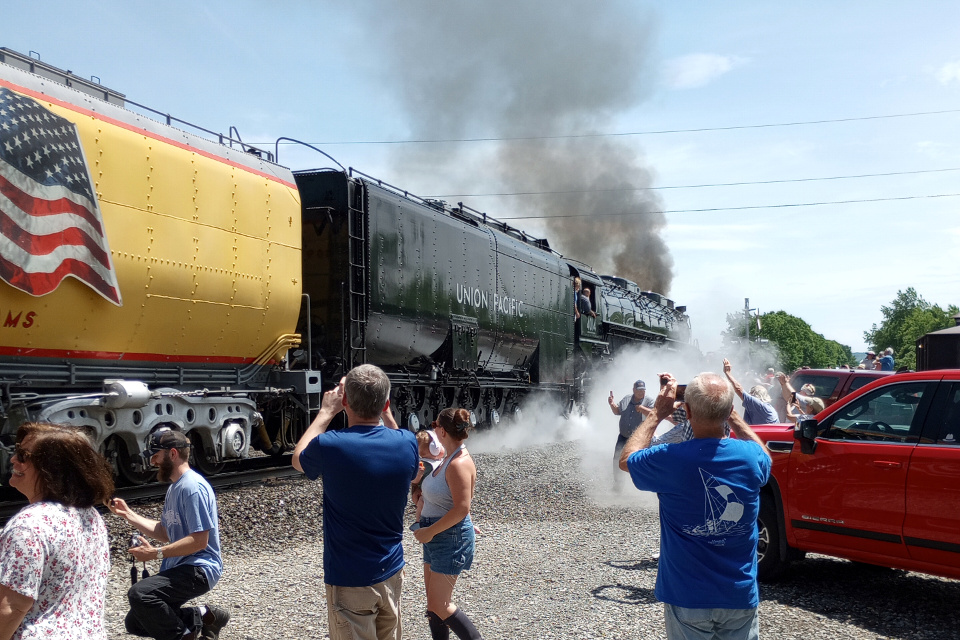
And suddenly, here it was, a locomotive I never expected to see, in a place I never imagined seeing it. Flags for the USA and the State of New York flew on its pilot. Eight white-rimmed drivers rolled past, just feet away from me. The final blast of the whistle for Short Tract Road was deafening. I took just two shots with my phone. I wanted to experience as much of this brief moment as possible.
The auxiliary tenders, the diesels in semiquincentennial paint, a long string of streamlined passenger cars in Armor Yellow passed by. I allowed myself one selfie. The Norfolk Southern cars, shining in maroon, passed. Finally, one heavyweight business car in Pullman Green, and it was over. The gates rose up, and the whistle faded.
The Union Pacific excursion team, in its promotional materials, strongly advises spectators to stay back 25 feet. Offenders risk getting steamed by the crew as the locomotive passes by. You can see them doing it in innumerable videos, where the crowds are pressing in too closely. I don’t know if we were the full 25 feet back; I think I was maybe 20 feet away, and Sara was a little closer for photos, but we did not get steamed. From the photo above, it appears that some people at the crossing did.
We waited ten minutes for the crowd to thin out, made our way back to Route 436, and endured the biggest traffic jam that Nunda’s lone four-way stop has ever seen. We took a lightly-trafficked back way towards home, and had our picnic on Susanne’s porch. That night, I looked at the numerous photos and videos that crossed my feed from other, more photogenic locations. I read a first-hand account of chasing the Big Boy all the way from Silver Springs to Waverly, by someone who sounded thoroughly miserable from the experience.
I went to bed happy that night.

